How messed up is your island? Check out our before/after comparisons of every Maldivian island. Click here.
But before that, read our editorial on the dramatic changes that happen in the Maldives regarding geo-engineering, dredging and destroying.
See through the marketing of “untouched natural beauty” while entire reefs have been destroyed for your stay.
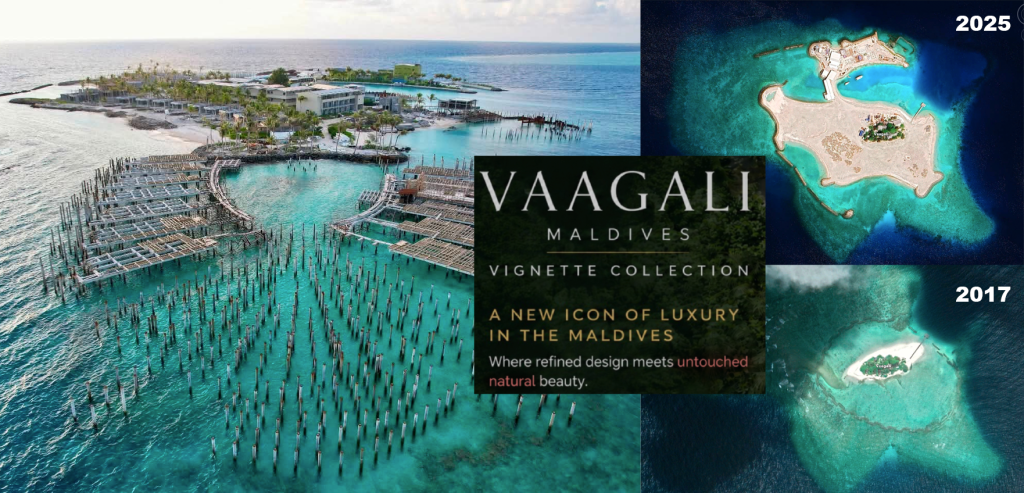
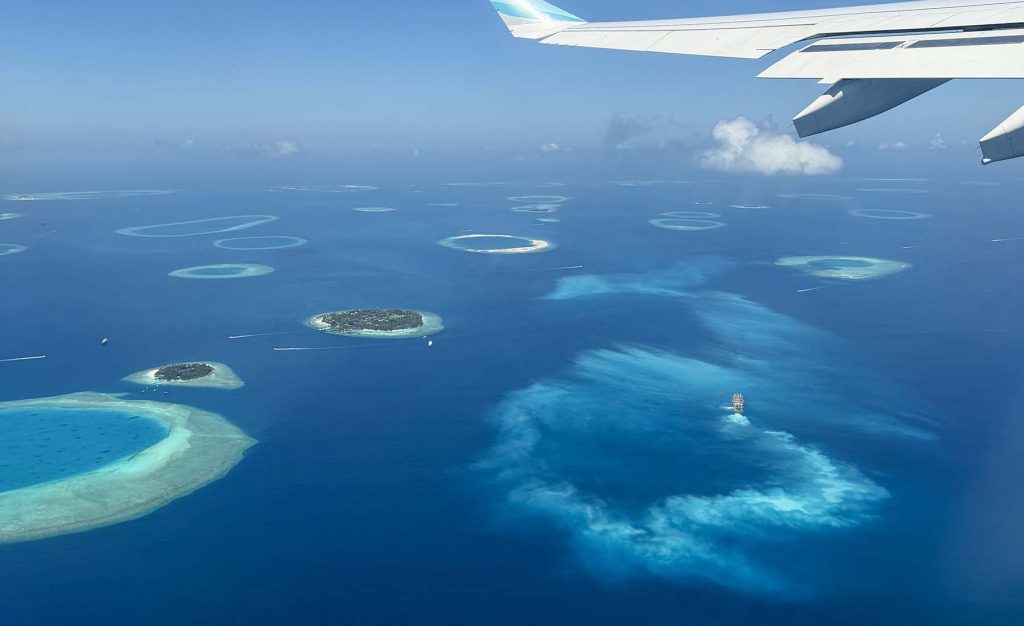
The Maldives. What used to be a natural wonder has become an artificial nature defying dredging heaven, spilling out new islands on a monthly basis. Ever after finding out about ‚terraforming‘, the dredgers run day and night to do two things: first: protect existing local land from rising sea levels and coastal erosion. Second: make new islands onto existing reefs and sell them to the highest bidder of the tourism industry.
While the first is an understandable move to stabilize land area for the country as a measure to fight the existential threats for a low lying country, this page is only here to critisize the second: The vandalisation of the nature for the sake of an uncontrolled tourism growth.
Why is this worth critisizing?
- Immediate threat to the coral ecosystem. The dredging process involves month-long pumping and accumulating sand from deeper areas of a reef on top of a living reef. Any existing corals will be buried plus since this happens within the open sea in the face of swells, tides and currents, heavy sedimentation is being carried in different directions to closer or even further away reefs and into deeper areas, compromising the coral health.
- Long term questions: Time will tell how resilient the newly formed islands will be against swells, waves, storms and currents. It takes thousands of years for an island to being born. Behind the protection of a coraline barrier sand accumulates, plants grow, fertile soil is composting, a fresh water reservoir develops in the deeper area below the island, animals arrive, monsoon and tidal currents form the shoreline. It could mean that more solid shore protectors aka barriers must be built and/or a permanent dredging must replenish the sand.
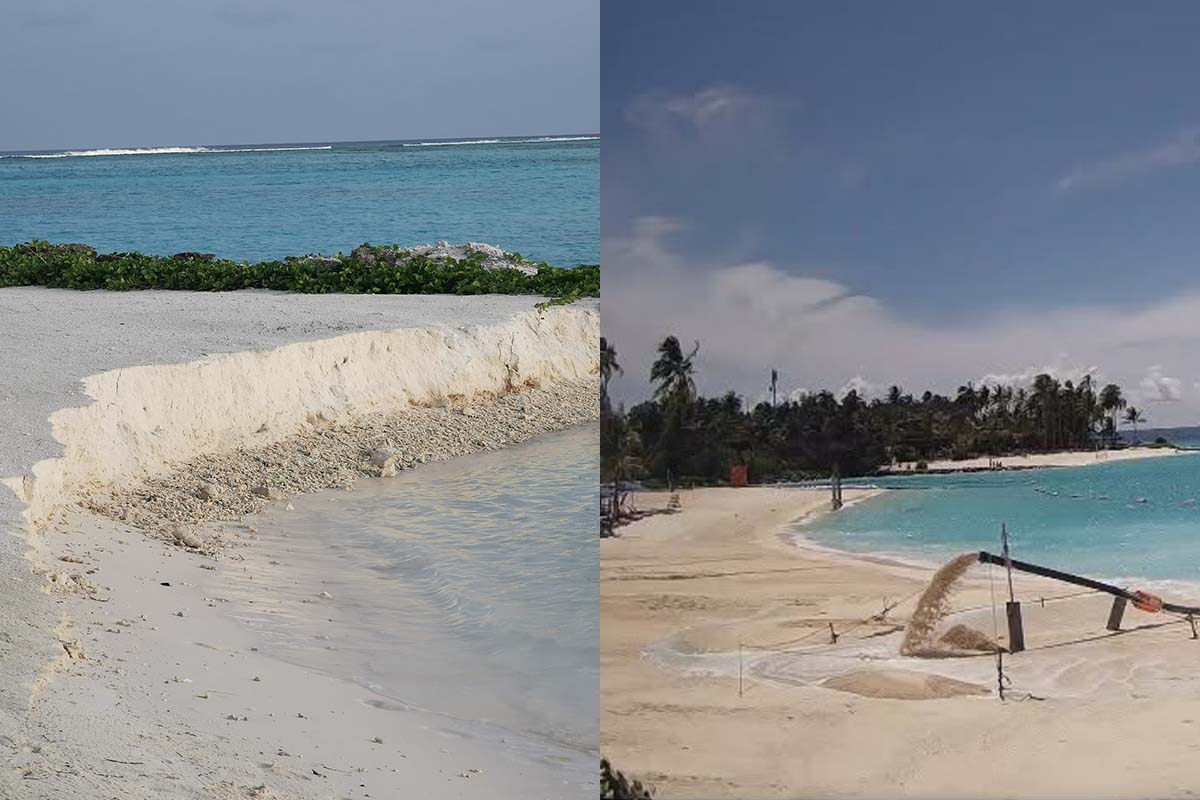
- Missing natural aspects: A natural Maldivian island is a living and breathing system, even after it has been chosen by locals to live on or after being transformed to a tourist resort. The ground is not only sand and coral parts, but a fertile soil made over hundreds of years of plants’ life cycles. Any artificial island is at first completely dead. There is not a single living cell, not a single root, not a single animal. It’s sand and coral debris pumped from the depths of the sea and dried in the sun, compacted to a sand castle. There is nothing fertile in it and every plant that will be plugged into this dead ground will have a hard time surviving. Every artificial island will feel hot and dry, missing an ecosystem, breathing forest, humidity storing soil, natural shadow. The paths are hard as cement since there is no softening layer of natural soil. Every palm has been taken from a natural island in the Maldives (importing coconut palm trees is forbidden) which can cause other problems: damaging an existing forest, weakening coastal structures, raising local anger (mvtreegrab). It will take centuries for nature to merge the human efforts and build a new ecosystem.
- Loss of identity: Are the Maldives still the same if they change so much? Is this a philosophical question? Yes, and so there is no neutral answer. But let’s look at Male Atoll alone. In the year 2000, just 25 years ago, there were 11 local island communities and around 40 resort islands. Today you still have 11 local island communities (plus Hulhumale) but 87 resorts PLUS 27 currently developed islands. A total of 140 human operated objects in this area has totally changed what it used to be. If you look for ‚untouched nature’ — you won’t find that in this atoll. The burden for the environment is massive, starting from boat traffic, waste production, fish demand, supply chain consumptions, carbon emissions to waste water dumping. And this is just North/South Male atoll. If you project the greed to sacrifice all this for the sake of tourism growth, then this spread like a desease to all the other atolls. Which, of course, has already started. Politically, it is astonishing that selling out to foreign investors is not considered being problematic with all its inflictions. Nobody said corruption out loud.
- Cultural impact: Bringing millions of tourists into the country will affect local life, especially when you allow unrestricted growth of guest houses in local communities. Not sure if every Maafushi-born Maldivian is happy with how their island looks today. In addition all the tourist resorts require staff and despite regulations aiming 50% workers from Maldives, reality tends towards 70%, raising political and social turmoil.
- Collateral damages: If a reef will bounce back depends on so many factors, but rest assured that a lot of damage will be done and entire reefs will be buried. If you know the Maldives, you know how beaches shift during a year following tides, currents and seasonal swell. This relies on current patterns that have formed over thousands of years: sand is being transported around the island core and accumulated on different areas. This is a balanced process that nature has invented. New islands with massive barriers, huge amounts of sand taken out of channels may change century old current patterns within reef and island systems. Nobody could have calculated that beforehand. More tourists means infrastructure must grow accordingly, which is already happening, building new airports in every atoll, for example. On artificial islands, of course.
- Missing foresight: Just one example. Fishing industry is no.2 in national revenue, plus it feeds the Maldivians themselves. 2026 shows record low catches with fishermen complaining about extended search for bait fish and poor overall catch. Once abundant species are rarely seen. Bait fish is vital for the tuna pole-and-line fishing. Fishermen need to catch significant amounts with nets, which is typically done in shallow reef areas and lagoons. This is a very complex system and sure enough global changes in climate and sea surface temperatures contribute to local changes in fish populations. But who connects the dots between transforming lagoons and shallow reef areas to tourism exploitation, the degeneration of coral reefs to weeker marine ecosystems and feeding 2 million tourists per year? When protection of marine habitats, the Maldivian reefs, the foundation of the Maldivian identity plays no role in this uncontrolled and inconsiderate geoengineering madness, then who will tell the Maldivian fishermen why they catch less? What usually happens in this scenario is already happening in the Maldives: desperate fishermen put even more pressure on the ecosystem, for example by attracting bait fish with underwater lights during the night, using longer lines and more hooks, using smaller-meshed nets for bait fish, going for protected species which are easier to catch (sharks, turtles, wrasses, parrot fish etc.), banned techniques like spear fishing being used, catching premature lobsters …
The greed of the tourism industry (and the partnering politicians) will try everything to obscure this exploitation. And we, the tourists, are being fooled. Advertisement will never mention that an island is being totally artificial. You will never know until you arrive or ask about it beforehand. They will let us believe that all islands are the same, which is a lie. That’s how Vaagali became the hero of this page: a once natural island, owned by a Maldivian family, sold to the dark side, built entirely new, and now attracting tourists with the slogan „Where design meets untouched natural beauty“. This is cynical. This collection shall help to quickly identify those Temu-islands.
Please consider natural islands with a low index for your stay!
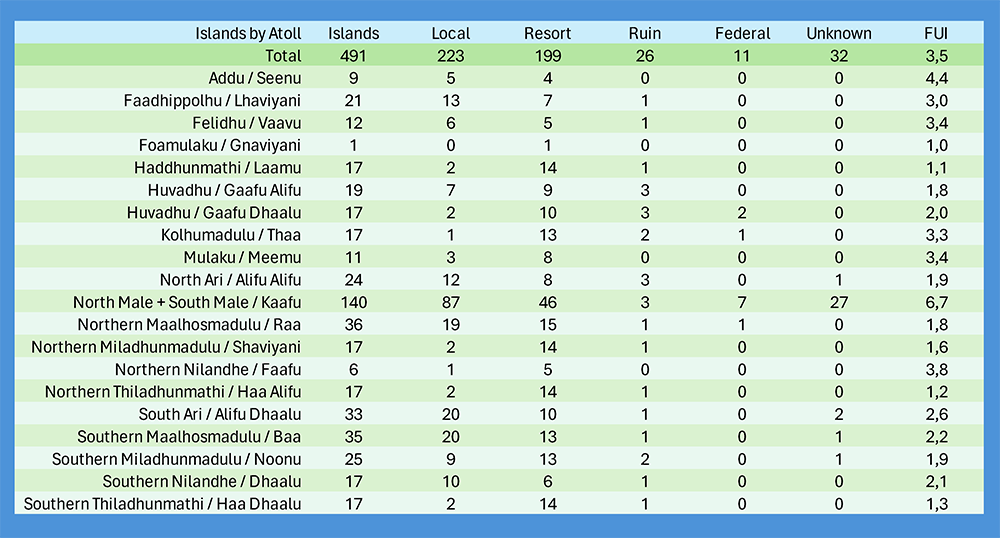
The index ranges from 0 (all natural) to 10 (totally new). Local islands have all gotten new harbours and this remains without deduction of points. Resorts with overwater bungalows automatically get a +1 for unnecessary reef destruction. And the whole rating is subjective and not scientifically backed.
Statistics
As one would expect, the worst average index is to be found in Male/Kaafu. North and South combined have now 140 islands, which is totally crazy. 87 resort islands vs 16 local islands and 27 ‘unknown’ which in most cases means we see dredging in a lagoon for another resort. 193 of 491 islands are marked as “entirely new” (76) oder “partly new” (117) – almost 40%. Can you imagine the dredging companies having an endless party? The further away from Male the better the index gets, meaning that you have to accept longer transfers for unspoiled Maldives experience. Also interesting that there are more than 20 ruins or abandoned resort islands. So much effort to build and now left for decay and polluting, including such famous names as Asdu, Velidhu, Madoogali, Zitalhi … seems to be cheaper to pump up a new island instead of re-building existing ones.
Disclaimer:
- All images are courtesy of Google Maps, Google Earth and Apple Maps. I hope they let us use them.
- The speed of change is dramatic, so the photos you see might be old at the end of the day. Many satellite images are old and keeping up with the development is almost impossible. What is a lagoon in 2025 might today be already a Temu-island in operation. This will be updated, but not on a regular basis.
- Please feel free to contact us if you find errors.
- I subdivided Male atoll in North and South despite knowing this is not correct — there is only one entire Male atoll.
- If there is an atoll mentioned behind an island name, then there are more than one islands with this name.
- Classification and statistics and the whole list are by no means officially backed and are soley based on personal research.